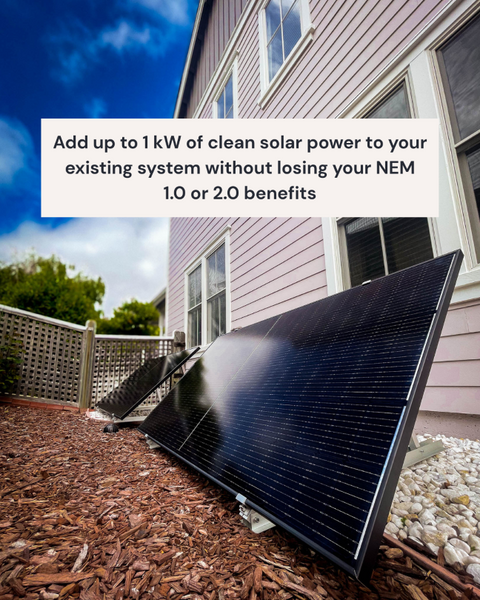
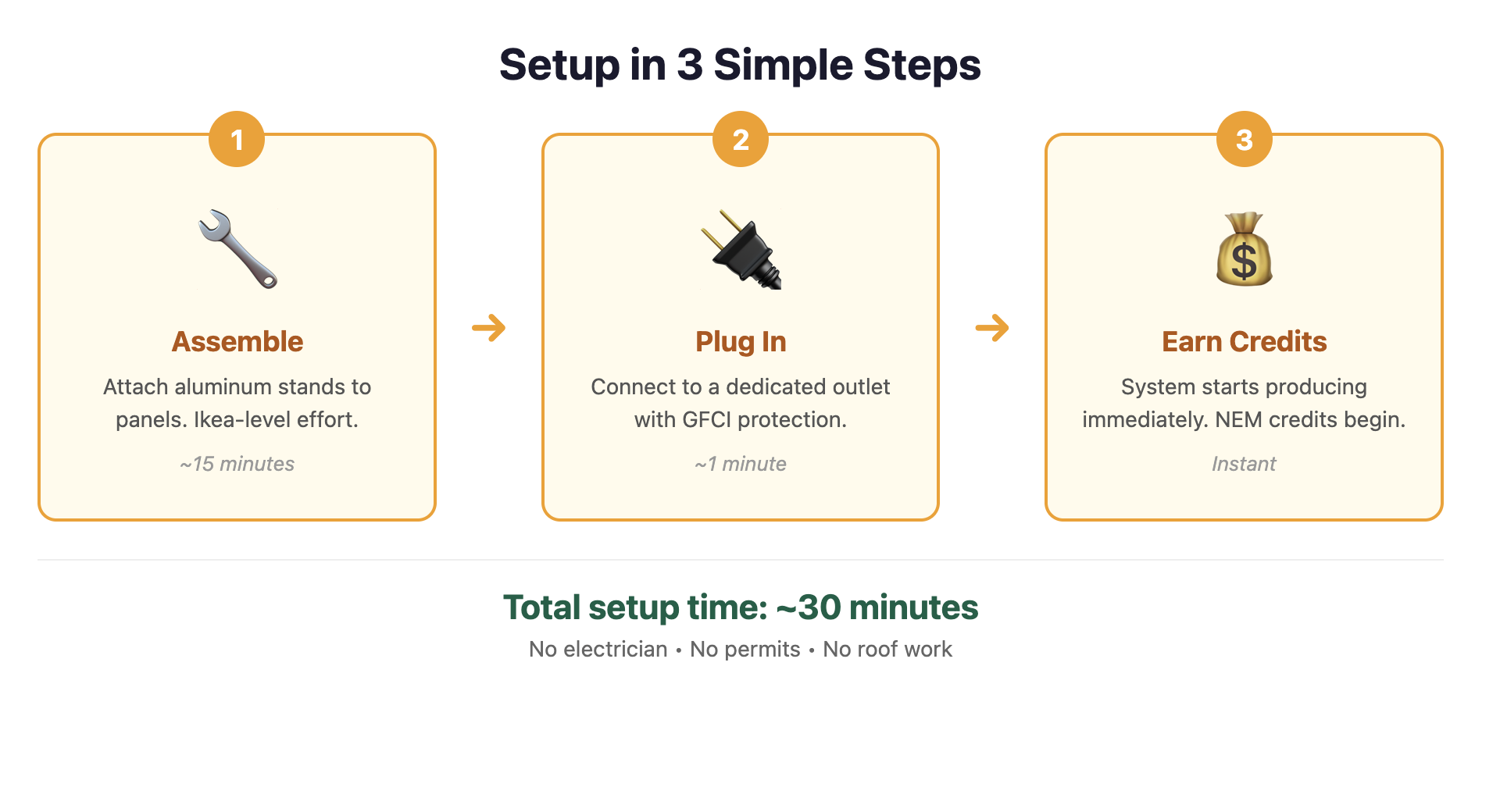
In short: A plug-in solar kit consists of solar panels and a microinverter that converts sunlight into standard household electricity. You assemble the panels (Ikea-style, ~15 minutes), plug into a dedicated outlet with GFCI protection, and start generating electricity immediately. Any excess flows back through your meter as NEM credits.
You bought a Bright Saver NEM Expansion Kit. Now what?
This guide walks you through exactly how plug-in solar technology works and how to set it up, step by step. If you're still deciding whether plug-in solar is right for you, start with our What Is Plug-In Solar? guide.
That's the entire system. Panels + microinverter + one plug = more NEM credits.
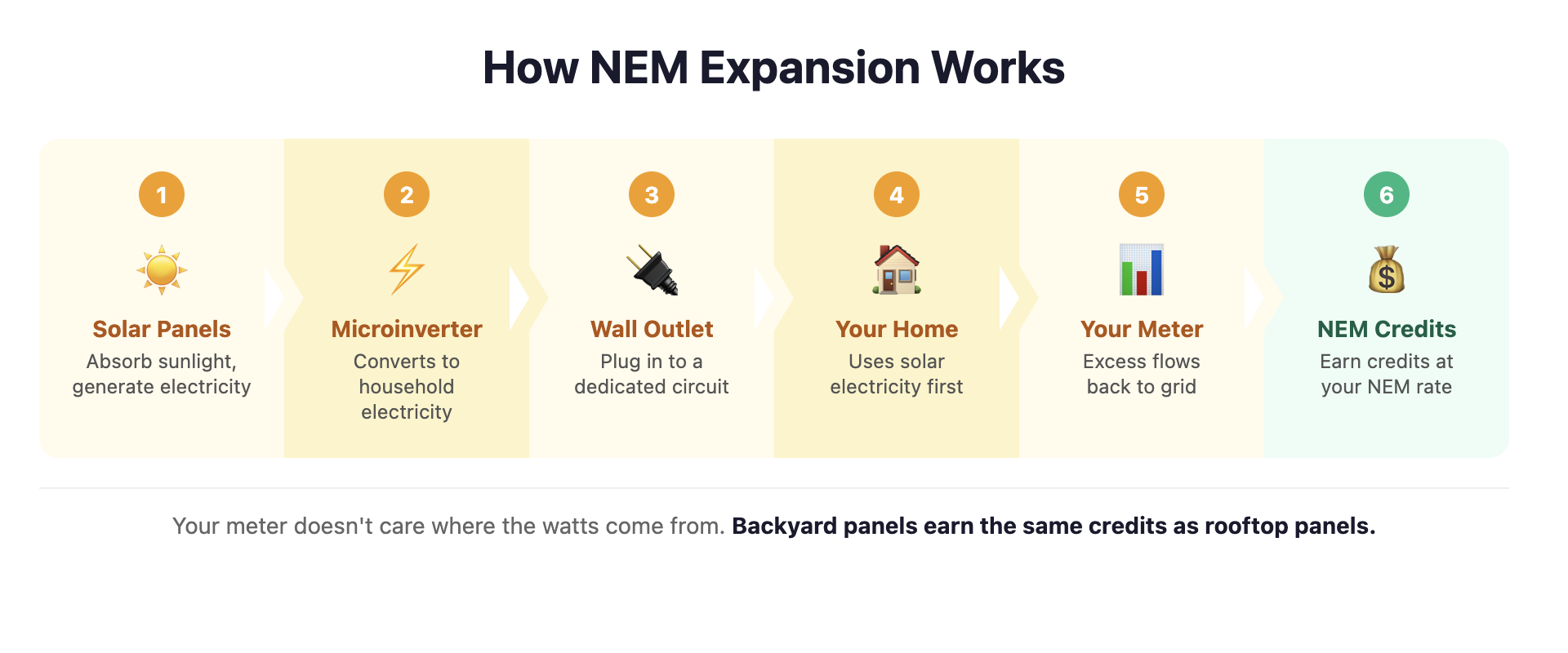
No drill. No ladder. No electrician (unless you need a dedicated circuit added — many homes already have one).
Find the sunniest spot available. In California, that usually means:
Good locations: backyard (ground-mounted), patio, balcony (railing-mounted or propped against a wall), side yard, or south-facing garage wall.
Pro tip: Check your chosen spot at different times of day. You want at least 4 to 5 hours of direct sun daily for good production.Your kit includes:
Inspect for shipping damage before assembly.

Assembly is Ikea-level effort. No special tools needed beyond what's in the box. Panels don't need to be permanently fixed — many people adjust seasonally.
Connect the panel's DC cables to the microinverter input. Connectors click into place and are weatherproof. Multiple panels connect in parallel with color-coded cables.
Plug the AC output cable into a dedicated circuit with GFCI protection. The system begins producing immediately. The microinverter LED lights up to confirm it's active.
Outlet requirements:If you're not sure whether you have a dedicated circuit, an electrician can check and add one if needed. This is typically a quick, inexpensive job.
Your panels produce 900W, your home draws 1,500W. Your home uses all 900W of solar and pulls only 600W from the grid. You save on the 900W you didn't buy.
Your panels produce 900W, you're only using 200W. Your home uses 200W from solar. The remaining 700W flows back through your bi-directional meter to the grid, earning you NEM credits at your existing NEM rate. This is the core value of the NEM Expansion Kit — every excess kilowatt-hour earns credits just like your rooftop panels.
Panels produce little or no electricity. You draw from the grid as usual. Your NEM credits offset those costs at true-up.
For a 2-panel system (~800W nameplate) in California:
| Season | Daily Production | Monthly Production |
|---|---|---|
| Summer (Jun–Aug) | 3.8 to 4.5 kWh/day | 115 to 135 kWh |
| Spring/Fall | 2.8 to 3.5 kWh/day | 85 to 105 kWh |
| Winter (Dec–Feb) | 2.0 to 2.5 kWh/day | 60 to 75 kWh |
| Annual Total | ~1,200 kWh/year |
A 4-panel system produces approximately 2,200 kWh/year (not a full doubling due to inverter clipping on peak sunny days — about 10% annual energy loss, which is offset by higher production in mornings, afternoons, and cloudy conditions).
At Northern California NEM rates (~$0.30/kWh):
| System | Annual Production | Annual NEM Credits | Payback |
|---|---|---|---|
| 2-Panel | ~1,200 kWh | $360/year | 4.6 years |
| 4-Panel | ~2,200 kWh | $660/year | 3.9 years |
SCE and SDG&E rates are higher (~$0.32 and ~$0.36/kWh), which means faster payback in Southern California and San Diego.
The included microinverter connects to a smartphone app that shows:
No moving parts, no fluids, no filters. Panels come with a 10-year warranty and typically produce for 20+ years.
Yes. If you can assemble Ikea furniture, you can set up plug-in solar.
What if I don't have a dedicated outdoor outlet?An electrician can add one — typically a quick, inexpensive job. You can also run the cable through a window or door to an indoor dedicated circuit. Most California homes already have dedicated circuits in the garage (required by NEC code), laundry room, and kitchen — the garage is often the most convenient option since it's close to your backyard or side yard.
Cloudy days?Panels still produce at 10 to 30% of rated output. California averages 260+ sunny days per year.
Power outages?System automatically shuts off within milliseconds (anti-islanding safety feature). This protects utility workers and your home.
Will it work with my existing rooftop solar?Yes. The plug-in system operates on a separate circuit. Your rooftop system keeps working exactly as before. Both contribute to your NEM credits through the same bi-directional meter.
Bright Saver's NEM Expansion Kits start at $1,499. A little Ikea-style assembly, plug in, and start earning more NEM credits the same day.
Shop NEM Expansion KitsFree pickup from our Oakland or Los Angeles warehouses. Delivery + installation support available within 50 miles of Oakland for $349.
Bright Saver is a 501(c)(3) nonprofit. Our mission is making solar accessible to every American.