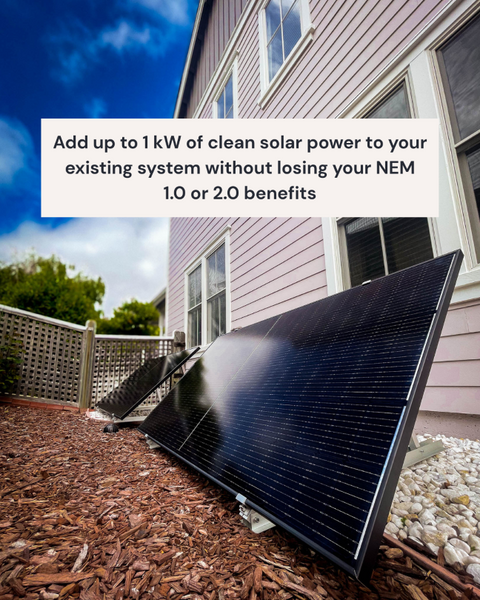
Direct answer: No, you will not lose your NEM 1.0 or NEM 2.0 status by adding a plug-in solar expansion kit. California's three major utilities (PG&E, SCE, SDG&E) all allow NEM customers to expand their solar capacity by up to 1 kW or 10% of the original system size without any change to their existing NEM rate.
When it comes to upgrading your home's solar setup, California's rulebook is actually on your side. The state has an established, straightforward pathway that lets you add additional panels without triggering a massive utility review. Let's break down the exact rule that protects your current rate while letting you generate more energy.
Note: This post is for informational purposes. It is not legal advice. Consult with a qualified attorney or your utility for guidance specific to your situation.California's three major investor-owned utilities (PG&E, SCE, and SDG&E) all have a published rule that allows NEM 1.0 and NEM 2.0 customers to expand their solar generating capacity by up to 1 kW or 10% of the original system size, whichever is greater, without losing their existing NEM rate.
This isn't new. It's part of the existing NEM tariff, confirmed in PG&E's NEM2 Sunset FAQ, published on their interconnection portal, and grounded in CPUC Decision D.22-12-056. It was originally designed so that homeowners could do maintenance replacements without triggering a transition to the less favorable Net Billing Tariff (NEM 3.0/NBT).
Here's the key point: the rule establishes how much capacity you can add without losing your NEM rate. Bright Saver's NEM Expansion Kits are designed to work within this allowance — using UL 1741 SB certified microinverters with the same safety standards as grid-connected rooftop systems. Your utility may require a quick registration for the expansion — check the utility-specific details below.
A Bright Saver NEM 2-Panel Kit adds approximately 800W of generating capacity to your existing grid-connected solar system. For customers whose 10% threshold exceeds 800W (original systems of roughly 8 kW or larger), this fits comfortably within the expansion allowance. Our NEM 4-Panel Kit pairs approximately 1,600W of panels with a 900W inverter, keeping the system's maximum output within the 1 kW expansion limit.
Because you already have an interconnection agreement with your utility, you're not starting from scratch. You're adding a small amount of capacity to a system that's already on the grid. By staying within the published expansion limits, you're working inside the utility's own rules. No new interconnection agreement. No tariff change. Just more solar.
There's a second, complementary rule. PG&E, SCE, and SDG&E have approved methods for adding generation capacity to an existing NEM system as a "non-export" addition under Rule 21. If additional capacity is configured so it doesn't export power to the grid, the customer's original NEM period is not affected at all.
Plug-in solar systems are inherently oriented toward self-consumption. Our kits are designed to offset your household's real-time electrical load. On a typical day, a home running a refrigerator, WiFi, some lights, and a few other appliances will consume more power than the system produces. The solar energy gets used before it ever reaches the meter.
Both are published utility rules. Both are grounded in CPUC decisions. Neither requires waiting for new legislation.
PG&E references the expansion allowance in their NEM2 Sunset FAQ and does not require a new interconnection application for expansions within the 1 kW / 10% limit. You're working within your existing agreement.
SCE CustomersSouthern California Edison requires an interconnection review before granting Permission to Operate (PTO) for system modifications. Contact SCE to confirm current processing times for NEM expansions within the published limits.
SDG&E CustomersSDG&E follows the same CPUC expansion rule — NEM 1.0 and NEM 2.0 customers can add up to 1 kW or 10% without losing their existing NEM rate. Like SCE, SDG&E requires a modification request through their Solar Application Portal for changes to an existing NEM system, including adding panels. This is a registration process, not a new interconnection application.
California's SB 868 (the Plug Into the Sun Act) would go much further by reclassifying all plug-in solar devices up to 1,200W as household appliances — like a toaster or a window AC unit — exempting them from interconnection requirements entirely.
This is where the real accessibility breakthrough happens. The NEM expansion rule helps existing solar homeowners, but SB 868 would open plug-in solar to everyone: renters who have never had access to solar. Low-income households that don't own their roof. Apartment dwellers with a sunny balcony but no roof access. Communities in California's extreme heat zones — the Inland Empire, the Central Valley, parts of LA — where electricity bills are crushing families and where grid reliability is weakest. SB 868 would let any Californian plug in a panel and start generating their own clean energy, no utility permission needed.
As of March 2026, SB 868 has been amended and re-referred to the Senate Energy, Utilities & Communications Committee. It has broad support but has not yet been voted into law.
We're actively supporting SB 868 because it represents the future of energy access in California. But here's the thing: if you already have rooftop solar under NEM 1.0 or NEM 2.0, you don't have to wait for SB 868. The rules that let you add a small amount of capacity already exist.
All Bright Saver kits include UL 1741 SB certified microinverters (listed on the California Energy Commission's approved equipment list) with anti-islanding protection — the same safety standard used in grid-connected rooftop systems. They shut down within milliseconds when the grid goes down.
If you have rooftop solar on NEM 1.0 or NEM 2.0 and your energy needs have grown, adding a plug-in system within the published expansion limits is grounded in existing utility rules. It's the fastest, lowest cost way to get more solar capacity without losing the NEM rate you worked hard to lock in.
Free pickup from our Oakland or Los Angeles warehouses. Delivery + installation support available within 50 miles of Oakland for $349.
Bright Saver is a 501(c)(3) nonprofit. Our mission is making solar accessible to every American.