In short: SDG&E has the highest electricity rates of any major California utility (~$0.36/kWh NEM rate). A plug-in solar expansion kit earns $432-$792/year in NEM credits, paying for itself in 3.3-3.8 years — the fastest payback in the state.
San Diego: one of the sunniest cities in America, one of the most expensive electricity providers. SDG&E's bundled residential rate hit ~45.7 cents/kWh in early 2026, with TOU peak rates reaching 55 to 70 cents/kWh.
If you already have rooftop solar on NEM 1.0 or NEM 2.0, your exported electricity earns credits at or near those retail rates. That's an incredible deal compared to the ~$0.08/kWh that new NEM 3.0 customers receive. Every additional kWh you generate is worth real money.
SDG&E's published tariff allows NEM 1.0 and NEM 2.0 customers to expand their solar generating capacity by up to 1 kW or 10% of the original system size (whichever is greater) without losing their existing net metering rate.
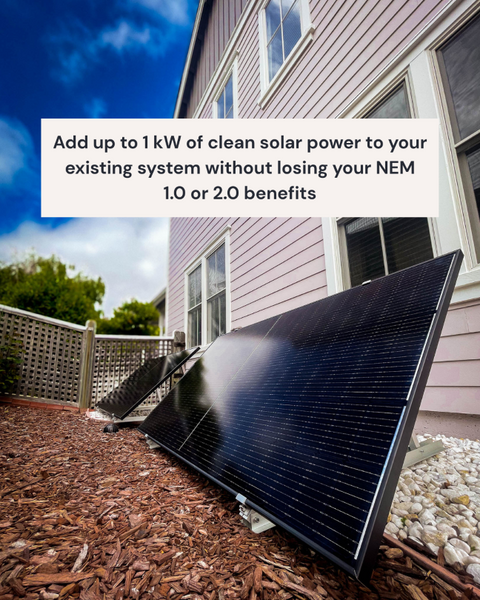
Bright Saver's NEM Expansion Kit lets you add 2 or 4 panels in your backyard. A little Ikea-style assembly, plug into a standard outlet, and start earning more NEM credits the same day. No contractor. No permits. No changes to your NEM agreement.
When your home is using less than the panels produce, the excess flows back through your existing bi-directional meter to the grid — earning you NEM credits at your existing NEM rate, just like your rooftop panels.
SDG&E NEM credit rates are the highest of any major California utility at approximately ~$0.36/kWh. Each panel earns roughly $216/year in net metering credits. San Diego's sunshine pushes production even higher.
| System | Price + Tax* | Annual NEM Credits | Payback Period |
|---|---|---|---|
| NEM 2-Panel | $1,649 | $432/year | 3.8 years |
| NEM 4-Panel | $2,583 | $792/year | 3.3 years |
The 4-panel system has a shorter payback because the third and fourth panels add production at a lower incremental cost, even though the 900W inverter clips peak output for a few hours on the sunniest days. Annual energy lost to clipping is only about 10%.
California electricity rates have been rising 5 to 8% per year. SDG&E has been among the most aggressive. Your NEM credits grow as rates increase, but your kit cost is locked in at day one.
| Year | Est. NEM Rate | 2-Panel Annual Credits | 4-Panel Annual Credits |
|---|---|---|---|
| Year 1 | $0.36/kWh | $432 | $792 |
| Year 5 | $0.44/kWh | $528 | $968 |
| Year 10 | $0.56/kWh | $672 | $1,232 |
| Year 20 | $0.91/kWh | $1,092 | $2,002 |
Over 20 years, a 2-panel kit generates over $14,000 in cumulative NEM credits on a $1,649 investment. A 4-panel kit generates over $26,000 on a $2,583 investment.
A 4-panel kit pays for itself in about 3 years in San Diego. Then it keeps earning for 22+ more.San Diego gets some of the best sun in California:
More sun hours = more kWh = more NEM credits.
When your home is using more electricity than your panels produce (common during high-use periods), the solar energy gets consumed directly. In that case, you're saving at your full retail rate (~$0.457/kWh or higher during peak TOU periods). Either way — credits or self-consumption — you save.
Whether you're bundled with SDG&E or with San Diego Community Power (SDCP), plug-in solar still reduces your total bill by offsetting kWh from both delivery and generation components. Your NEM agreement typically applies regardless of your generation provider.
SDG&E allows NEM 1.0 and NEM 2.0 customers to expand capacity by up to 1 kW or 10% of the original system size without losing their existing NEM rate. For full details, see our guide to NEM expansion rules in California. Check with SDG&E for current requirements regarding NEM expansions within the published limits.
No. SDG&E's published tariff allows capacity expansion of up to 1 kW or 10% of your original system size without losing your existing NEM rate.
What if I produce more than I use?Excess flows back through your meter and earns NEM credits at your existing NEM rate, just like your rooftop panels.
Do I need SDG&E's permission?Contact SDG&E to confirm current requirements for NEM expansions within the published limits. SB 868 would further simplify by classifying plug-in solar devices (up to 1,200W) as household appliances.
How does this compare to calling my installer back?A traditional 1-2 panel add-on costs $3,000 to $5,000, takes weeks to months, and requires permits and inspections. A plug-in kit costs $1,649, does some Ikea-style assembly, and starts producing the same day.
Free pickup from our Oakland or Los Angeles warehouses. Delivery + installation support available within 50 miles of Oakland for $349.
Bright Saver is a 501(c)(3) nonprofit. Our mission is making solar accessible to every American.