
In short: Plug-in solar panels are compact solar systems that plug directly into a standard wall outlet, generating clean electricity for your home. Already mainstream in Europe (4 million+ systems in Germany), plug-in solar is now available in the US for homeowners with existing rooftop solar who want to add capacity quickly and affordably.
Imagine generating your own clean energy without drilling holes in your roof, hiring a crew of contractors, or waiting months for permits. Plug-in solar is exactly what it sounds like: compact solar panels that plug directly into a standard wall outlet to power your home and lower your electric bills.
Whether you're a homeowner looking to expand an existing rooftop system, someone curious about the future of green energy, or a policy advocate tracking grid innovations, plug-in solar is poised to change how America generates power.
The technology is straightforward:
That's the entire system. Panels + microinverter + one plug = clean energy.
Plug-in solar isn't experimental or futuristic. Germany alone has over four million systems installed. Across Europe, millions of people — homeowners, renters, apartment dwellers — are plugging panels into their balconies and patios and watching their electricity bills drop.
The hardware is proven. The safety standards are established. The US is just catching up on the regulatory side.
Utah passed HB 340 in 2025, becoming the first state to create a legal framework for plug-in solar. As of March 2026, 24 states have introduced or are advancing plug-in solar legislation, with Virginia and Vermont closest to becoming the second state to pass.
Plug-in solar and rooftop solar are complementary technologies, not competitors. Think of rooftop solar as the heavy lifter for whole-home energy, and plug-in solar as the agile, modular addition that fills the gaps.
| Plug-In Solar | Rooftop Solar | |
|---|---|---|
| Installation | Ikea-style assembly, plug into outlet | Professional crew, roof work |
| Timeline | Same day | 2 to 8 weeks |
| Cost | $1,499 to $2,348 (+ tax) | $15,000 to $30,000+ |
| Cost per watt | $1.50-1.90/W (eliminates soft costs: labor, permitting, engineering) | $3-4/W (includes installation labor, permits, inspections) |
| Best for | Adding capacity, closing the gap | Whole-home offset |
| Portable? | Yes — take it when you move | Stays with the house |
| Permits | Minimal to none | Yes, multiple |
| Accessibility | Homeowners, renters (with SB 868), apartments, any sunny spot | Requires owned roof, structural assessment, professional install |
| Installer needed? | No | Yes |
Neither is better than the other. They serve different needs at different price points. But plug-in solar dramatically lowers the barrier to entry — both in cost and complexity — making clean energy accessible to people who have been locked out of rooftop solar.
While Europeans can plug solar into almost any apartment balcony, US electrical codes are still catching up to the technology. Right now, the clearest and most legally supported path to plug-in solar is for homeowners who already have rooftop solar under a Net Energy Metering (NEM) agreement.
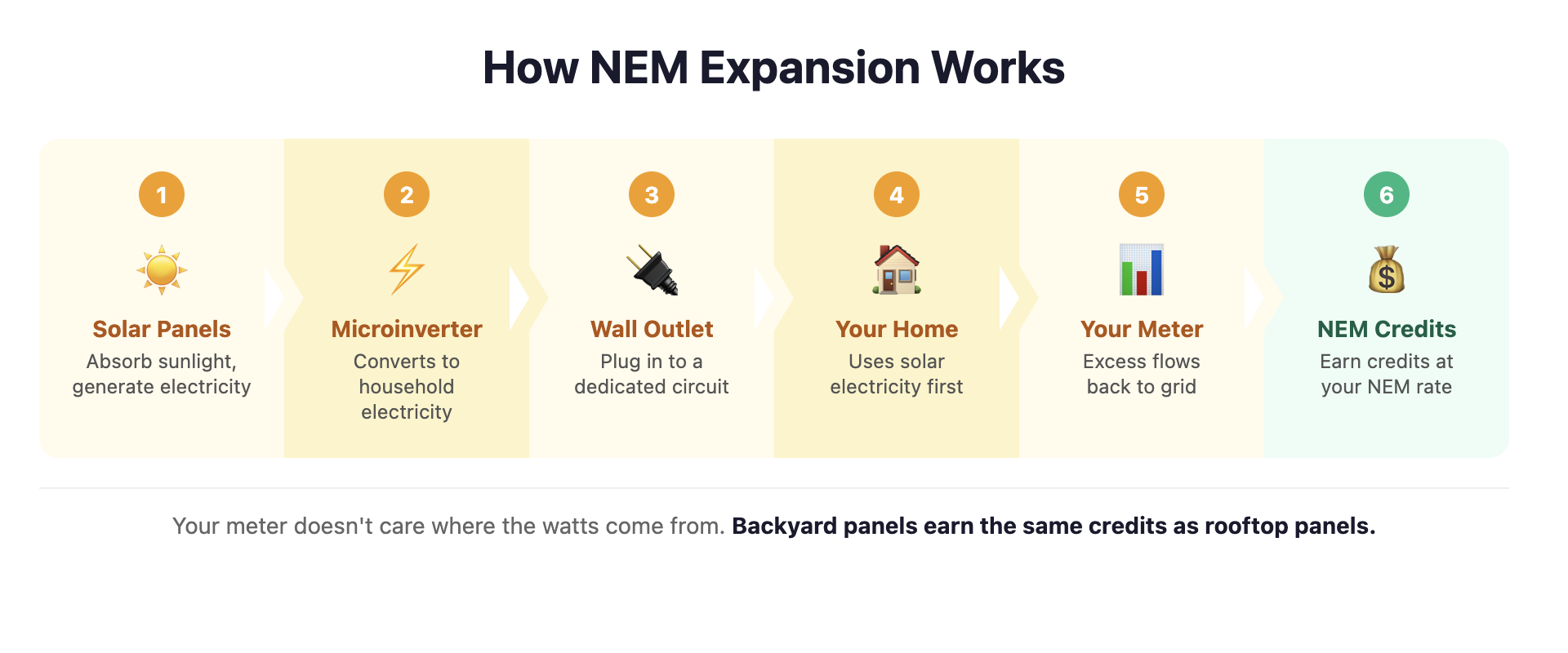
Here's why: California's three major utilities (PG&E, SCE, SDG&E) all allow NEM 1.0 and NEM 2.0 customers to expand their solar generating capacity by up to 1 kW or 10% of the original system size without losing their existing NEM rate. A plug-in expansion kit fits within this allowance.
If you already have rooftop solar and your energy needs have grown — you got an EV, added a heat pump, your family grew — a plug-in kit lets you add capacity the same day. No contractor. No permits. No changes to your utility agreement. And every kilowatt-hour your expansion kit produces earns NEM credits at your existing rate, just like your rooftop panels.
California's SB 868 (the Plug Into the Sun Act) would go much further by reclassifying all plug-in solar devices up to 1,200W as household appliances — like a toaster or a window AC unit — exempting them from interconnection requirements entirely.
This is where the real accessibility breakthrough happens. SB 868 would open plug-in solar to everyone: renters who have never had access to solar. Low-income households that don't own their roof. Apartment dwellers with a sunny balcony but no roof access. Communities in California's extreme heat zones — the Inland Empire, the Central Valley, parts of LA — where electricity bills are crushing families and where grid reliability is weakest.
As of March 2026, SB 868 has broad support and is moving through the Senate Energy, Utilities & Communications Committee.
As a 501(c)(3) nonprofit, Bright Saver is actively supporting SB 868 because it represents the future of energy access. But we aren't waiting for the laws to change to start making an impact.
If you're a California homeowner with existing rooftop solar on NEM 1.0 or NEM 2.0, you're uniquely positioned to take advantage of plug-in solar right now.
Bright Saver's NEM Expansion Kits let you add 2 or 4 panels in your backyard. A little Ikea-style assembly, plug into a dedicated outlet with GFCI protection, and start earning more NEM credits the same day.
At Northern California NEM rates (~$0.30/kWh), each panel earns approximately $180/year in net metering credits.
| System | Price + Tax* | Annual NEM Credits | Payback Period |
|---|---|---|---|
| NEM 2-Panel | $1,649 | $360/year | 4.6 years |
| NEM 4-Panel | $2,583 | $660/year | 3.9 years |
Over 20 years, a 2-panel kit generates over $11,000 in cumulative NEM credits on a $1,649 investment. A 4-panel kit generates over $21,000 on a $2,583 investment.

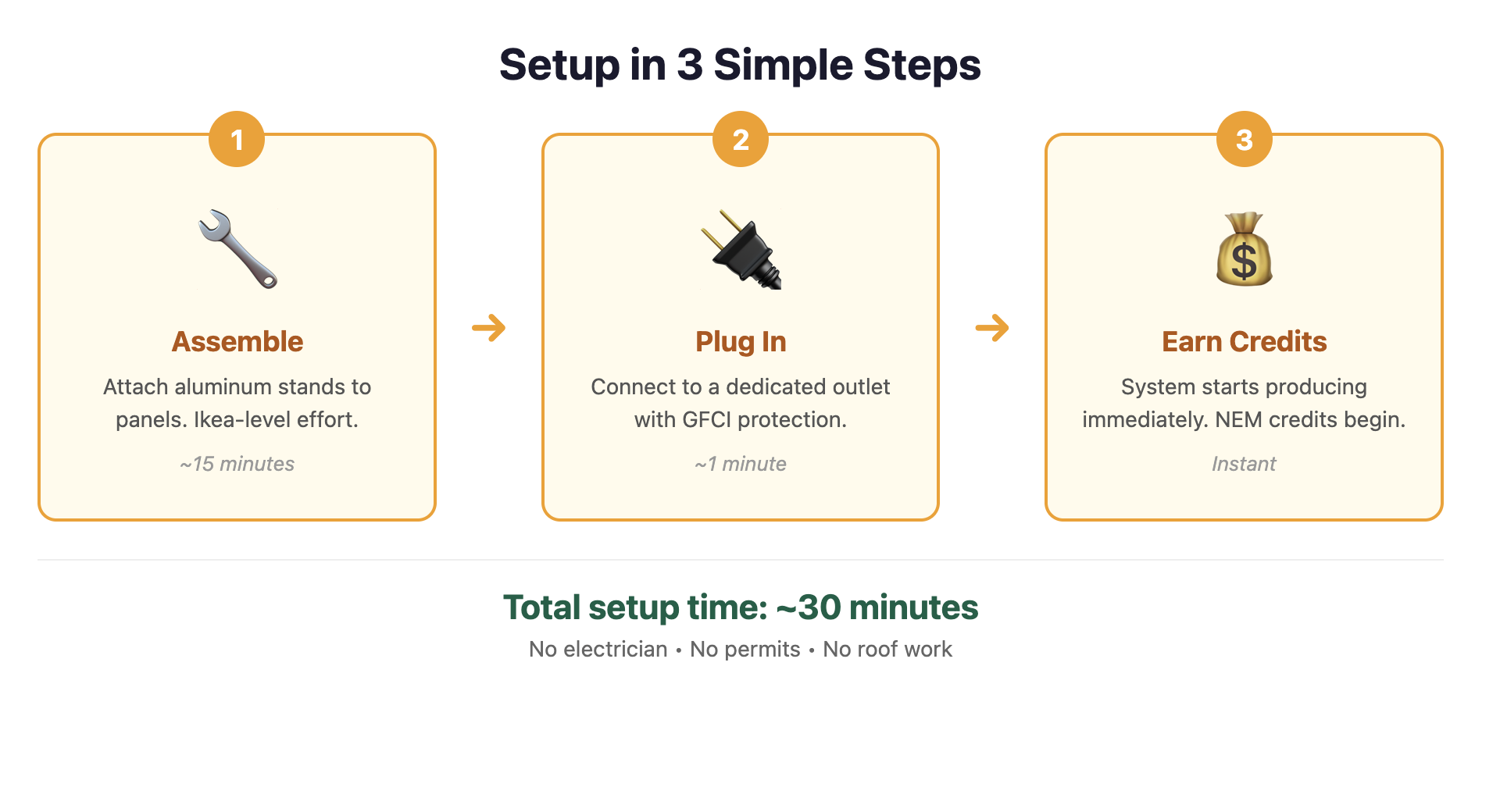
For a detailed step-by-step walkthrough, see our How Plug-In Solar Works setup guide.
Setup takes about 30 minutes:
Outdoor outlets also need a weatherproof cover.
Yes — into a dedicated circuit with GFCI protection. The microinverter converts DC to standard 120V AC. Anti-islanding protection shuts the system down within milliseconds during power outages.
Will this affect my NEM agreement?No. California's three major IOUs all allow NEM 1.0 and NEM 2.0 customers to expand capacity by up to 1 kW or 10% of the original system size without losing their existing NEM rate.
What if I produce more than I use?Excess flows back through your meter and earns NEM credits at your existing NEM rate, just like your rooftop panels.
I don't have rooftop solar. Can I still use this?Currently, Bright Saver's NEM Expansion Kits are designed for homeowners with existing solar on NEM 1.0 or NEM 2.0. If SB 868 passes, plug-in solar will be available to all Californians — including renters and homes without existing solar. Sign up for updates on our website.
How long do panels last?Solar panels typically produce for 20+ years. Panels and inverter both come with 10-year warranties.
Can I take it with me if I move?Yes. Unplug, disassemble, set it up at your new home.
Free pickup from our Oakland or Los Angeles warehouses. Delivery + installation support available within 50 miles of Oakland for $349.
Bright Saver is a 501(c)(3) nonprofit. Our mission is making solar accessible to every American.